
Productivity & leadership · 6 min read
Virtual Assistant Skills Test: A Practical Template
Assess a virtual assistant with a bounded work sample, consistent scoring, realistic tasks, and a clear distinction between training and client fit.
For Business owners choosing and managing remote teammates · By NextTeammate Research · Updated
Reviewed by NextTeammate Editorial · Published · 6 min read
The short answer
Direct answer
A useful virtual assistant skills test asks a candidate to complete a small, representative work sample using fictional or approved information. Provide the same brief, inputs, time allowance, tool rules, and scoring criteria to everyone. Assess accuracy, prioritization, communication, and judgment separately. Use the result alongside an interview and role requirements; a polished sample alone does not establish readiness for your particular workflow.
In this guide
Original NextTeammate framework
Key takeaways
- Test the responsibility you actually need someone to own.
- Publish the scoring criteria and AI rules before the exercise.
- Separate missing context from execution mistakes.
Start with one real responsibility
Choose a recurring result before choosing an exercise. If the role will prepare sales meetings, ask for a meeting packet. If it will coordinate customer onboarding, ask for a readiness tracker and an exception update. A generic typing test says little about whether someone can recognize a missing approval or produce information a client can use.
Write down the evidence you need: correct facts, appropriate priorities, traceable sources, and a sensible response to uncertainty. Keep the exercise proportionate. For substantial work, agree on compensation and usage in advance. Do not turn a selection exercise into unpaid production work or give candidates live customer credentials.
Copy this work-sample brief
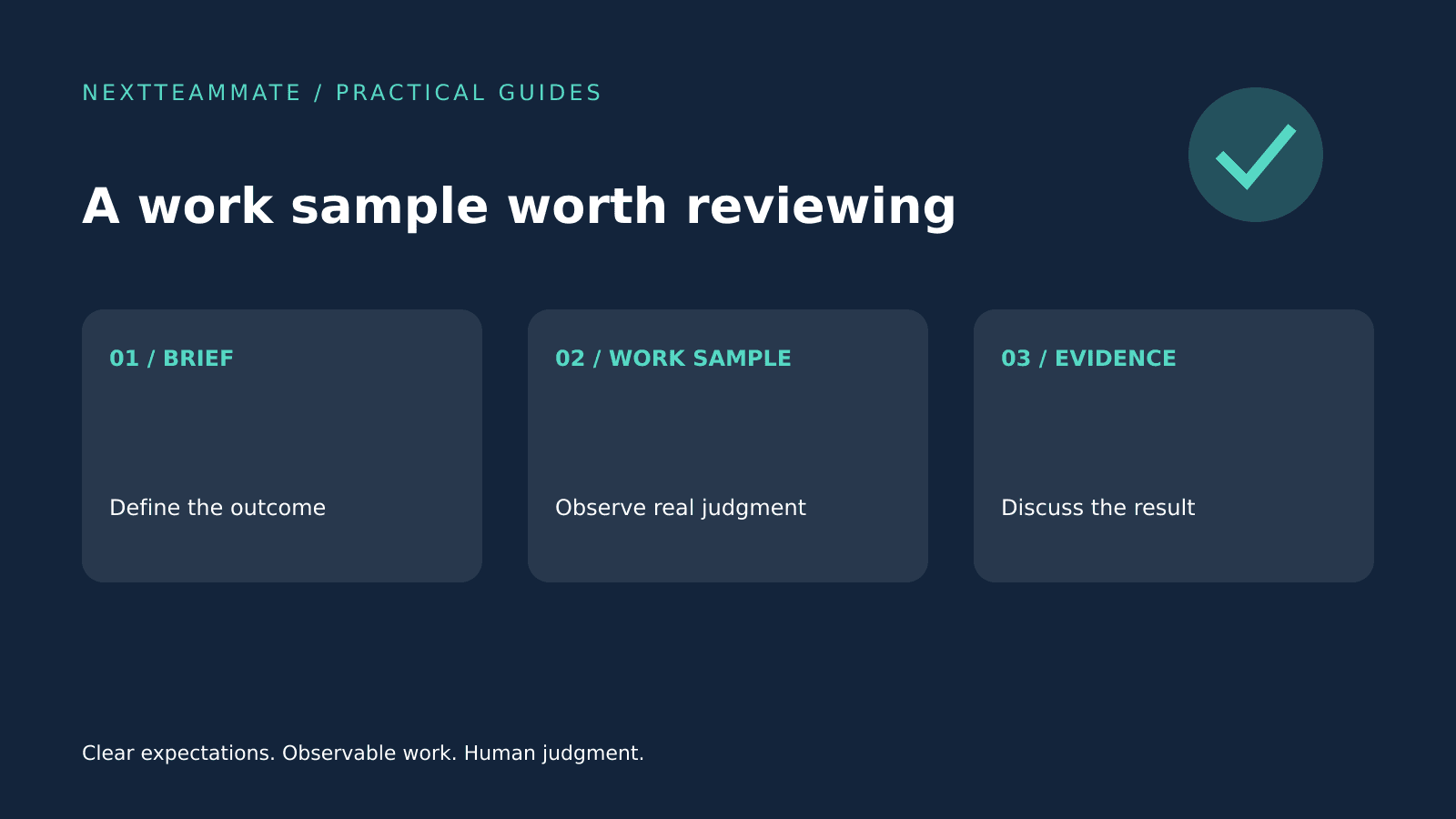
Outcome: prepare an internal meeting packet from the supplied fictional company profile, CRM notes, and calendar entry. Deliverable: a one-page summary with meeting purpose, confirmed attendees, previous commitments, open questions, and source references. Suggested allowance: 45 minutes for this illustrative exercise; adjust it to the actual role and communicate the allowance beforehand.
Provide an approved example of the format, the submission location, and the reviewer. State that the candidate may reorganize the information but must not contact anyone or invent missing details. Include one deliberately incomplete field and say that identifying unanswered questions is part of the task. The goal is observable judgment, not a hidden puzzle.
Use a consistent scoring rubric
An illustrative rubric assigns 0–4 points each for factual accuracy, completeness, prioritization, clarity, and handling uncertainty. Define the anchors: zero means no usable evidence; two means partly usable with material revision; four means accurate and usable within the brief. Write role-specific examples for the intermediate scores before reviewing submissions.
Record why each score was given. A total of 16 out of 20 is not automatically a pass if the candidate invented a customer commitment. Define critical failures separately, and distinguish a misunderstanding of your brief from a repeated capability gap. The rubric is a decision aid rather than a universal certification standard.
Make AI use explicit
Say whether AI is allowed, which information may enter approved tools, and what disclosure you expect. For an AI-enabled role, permitting assistance can produce a more realistic sample than banning it. Ask the candidate to explain what they checked, what they changed, and which uncertainties remained after drafting.
Evaluate the submitted work and the explanation rather than trying to infer authorship from writing style. A fluent answer can contain unsupported claims. Ask the candidate to trace one important statement back to the supplied source. Do not ask them to upload confidential business information into a personal AI account as part of the test.
Worked example: the missing meeting objective
The fictional calendar says “quarterly review,” while the CRM notes mention an unresolved rollout delay. A strong submission describes both facts and flags the meeting objective as unconfirmed. It might ask the reviewer whether the priority is account planning or resolving the delay. That keeps the ambiguity visible without stopping all preparation.
A weaker submission invents a renewal negotiation and presents it as confirmed. During review, ask where that conclusion came from. If it was an inference, discuss how it should have been labeled. This short conversation reveals more about practical judgment than a polished packet evaluated only for grammar or visual presentation.
Review the process with the candidate
Ask three questions: what did you prioritize, what could you not verify, and what would you do differently with more context? Give the candidate a chance to explain an unexpected choice. A different layout may still satisfy the brief, while a familiar layout can hide missing evidence.
Use the same core questions across candidates and record concrete observations. Avoid rating confidence, accent, or familiarity with your personal communication style as substitutes for work quality. If the task requires a particular language or schedule, evaluate that requirement directly and consistently rather than relying on assumptions.
Distinguish general readiness from workflow fit
Training completion, a work sample, and fit with a client answer different questions. Training shows exposure to required material; an assessment shows performance against defined criteria; a client-specific sample tests relevance to a particular responsibility. None removes the need to agree on scope, access, availability, and review ownership.
When considering a NextTeammate relationship, discuss the first workflow and what evidence would make the match useful. A candidate can be capable while needing orientation to your systems. Plan that orientation explicitly instead of expecting familiarity with undocumented conventions on the first day.
Turn the result into an onboarding plan
Choose among proceed, clarify with another bounded example, or stop for a documented requirement gap. If proceeding, carry the observed strengths and questions into the first-week brief. For example, strong research with weak exception labeling suggests a focused practice cycle on distinguishing facts, assumptions, and client decisions.
Review the first real deliverable against the same standards used in selection. If performance differs, inspect the inputs and access before blaming the person. Keep refining the test based on its usefulness in predicting the actual work, rather than making it longer each time something goes wrong.
Implementation checklist
Turn the guide into a working plan
- Choose one representative responsibility.
- Use fictional or approved source material.
- State scope, allowance, compensation, and usage.
- Share scoring anchors and critical failures.
- Specify AI and data-handling rules.
- Review evidence and the candidate’s explanation.
- Carry findings into a first-week plan.
Frequently asked questions
Questions leaders often ask
What is a good skills test for a virtual assistant?
Use a short sample of the work the person will own, such as preparing a meeting packet or organizing an onboarding tracker. Provide sources and score observable accuracy, completeness, communication, and judgment.
Should a virtual assistant test allow AI?
Allow it when that reflects the intended role, with clear tool and information rules. Require source verification and an explanation of the checks performed. The candidate remains accountable for the final output.
How long should the exercise take?
Keep it proportional to the decision. A small sample may fit a short agreed session, while complex specialist work needs a different scope. Tell candidates the expected effort and agree on compensation for substantial work.
Does passing a test guarantee a successful match?
No. The match also depends on the client’s workflow, availability, authority, access, communication, and expectations. Use the test as evidence for an informed trial and onboarding plan.
The AI-Native Work Brief
One practical idea. No AI hype.
Get field-tested delegation systems, useful AI workflows, and new research for building a human-led, AI-enabled company.
Occasional emails. Unsubscribe anytime.
Put the guidance into practice
Find support built around the outcomes you need.
Tell us what you want to get off your plate and review a recommended AI-native teammate.
Get My Free Delegation Blueprint