
Productivity & leadership · 6 min read
Virtual Assistant First 30 Days: A Scorecard
Use a first-30-days virtual assistant scorecard to track accepted outcomes, quality, blockers, review time, and readiness for more ownership.
For Business owners choosing and managing remote teammates · By NextTeammate Research · Updated
Reviewed by NextTeammate Editorial · Published · 6 min read
The short answer
Direct answer
A first-30-days virtual assistant scorecard records whether one agreed workflow produces useful, accepted results. Track completed cycles, first-review acceptance, revision causes, client review time, and unresolved dependencies. Review the evidence weekly with the teammate. Use the first month to improve the working agreement and decide whether to maintain, expand, or change scope; activity counts alone do not show value.
In this guide
Original NextTeammate framework
Key takeaways
- Measure accepted results before expanding scope.
- Record client dependencies alongside teammate delivery.
- Use weekly evidence to improve the working agreement.
Choose a workflow before choosing metrics
A scorecard needs a defined unit of useful work. “Help with operations” is too broad to measure fairly. “Prepare the weekly customer follow-up queue with current status and draft next actions” gives both participants something concrete to inspect. Name the owner, reviewer, sources, due time, and acceptance criteria before counting results.
Limit the first scorecard to a responsibility with enough ordinary cycles to learn from. If a workflow runs monthly, thirty days may offer only one observation. State that limitation and extend evaluation instead of pretending a tiny sample proves dependable performance. The dates are a planning frame, not a guarantee of competence.
Copy the scorecard fields
Use these fields for each cycle: expected outcome; planned due time and time zone; deliverable link; submitted time; accepted time; accepted on first review; revision reason; client review minutes; blocked time; dependency owner; and next improvement. Keep definitions beside the tracker so both people count the same events.
Separate submitted from accepted. A deliverable may arrive on time but still require factual correction. Conversely, accepted work may wait because the client missed a review window. Both facts matter. Do not overwrite the original timestamp when a revision arrives; record the sequence so the discussion reflects what happened.
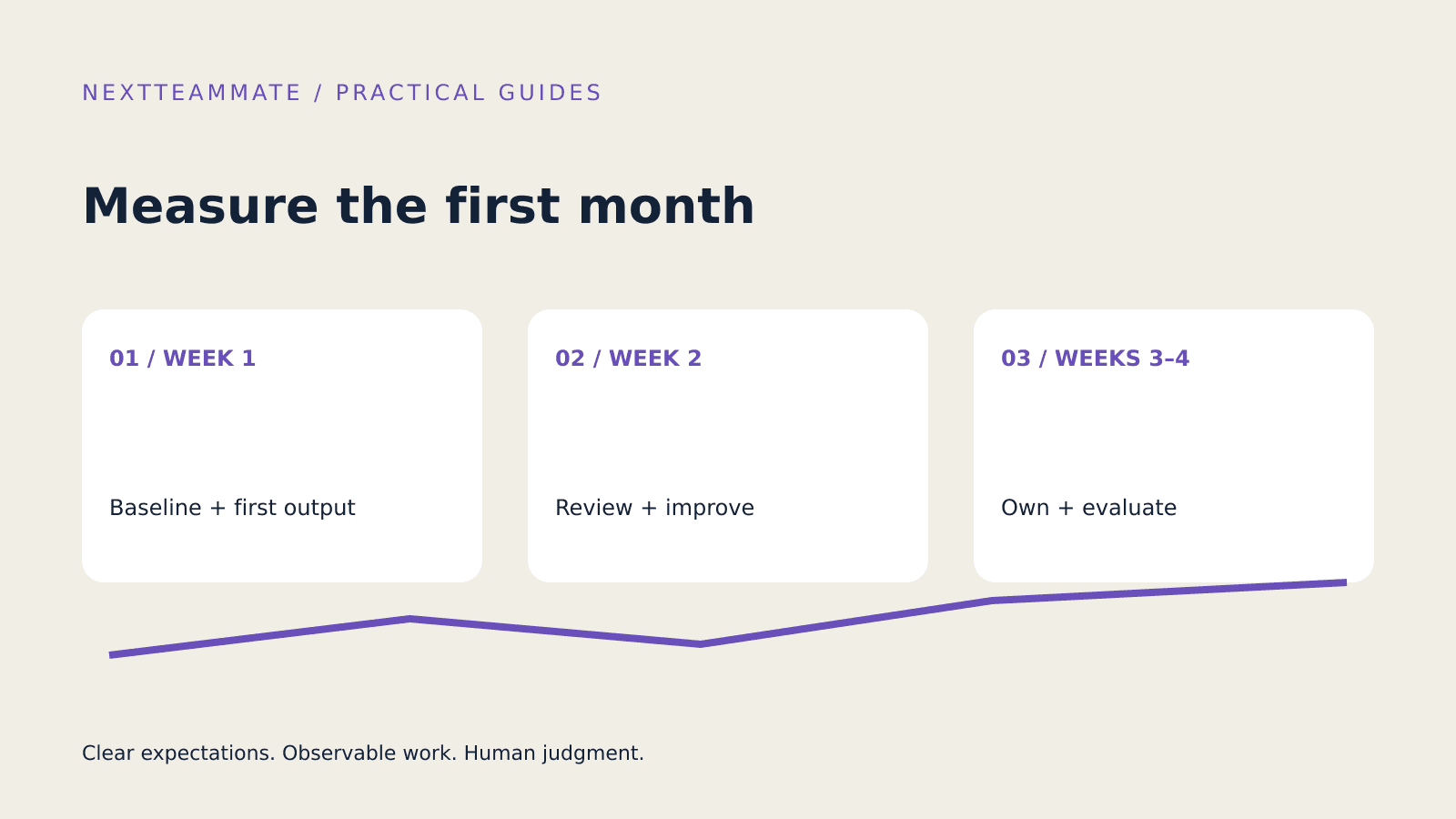
Week one: establish a baseline
Observe the existing workflow and document one acceptable example. Estimate current owner effort, including searching, execution, checking, and follow-up. Record what is measured and what is only a recollection. A rough estimate can be useful if it is labeled; it should not become a precise savings claim.
During the first cycle, prioritize access, context, and quality over speed. Ask the teammate to explain the definition of done and identify unclear decisions. Use a bounded First Win: one accepted output that matters to the client. Review it together, then update the instructions while the experience is still fresh.
Week two: examine revision causes
Group corrections into missing context, source problems, execution errors, and changed client requirements. These categories point to different fixes. Missing context needs a better brief; an execution error may need practice; a changed request requires a new agreement. A single revision total cannot explain which intervention will help.
Track first-review acceptance as accepted without material revision divided by reviewed submissions. Display the count with the percentage: two of three is more informative than a bare percentage. Agree on what counts as material. A corrected typo and an incorrect customer commitment should not carry identical weight in the discussion.
Week three: test ordinary ownership
Once the workflow is stable, let the teammate run a normal cycle with agreed checkpoints rather than constant direction. Observe whether they obtain inputs, flag exceptions, and submit evidence without being chased. Keep the client available for decisions that remain theirs. Independence does not mean removing the route for questions.
Add only one adjacent responsibility if capacity and quality support it. For a follow-up queue, that might be preparing approved draft messages while the client retains sending authority. State the new boundary and watch whether the extra scope increases review time or causes the original workflow to slip.
Worked example: a weekly meeting packet
Suppose four packets are reviewed during the month. Three are accepted on first review; one needs a missing source added. Client review takes 12, 10, 8, and 8 minutes. Two packets wait on late client inputs. These illustrative figures suggest useful questions about source completeness and input timing, rather than proving a universal benchmark.
At the review, retain the source checklist, move the input deadline earlier, and agree on an exception note when the source is unavailable. Do not describe the late-input cycles as teammate failures. Compare total client effort with the baseline using comparable scope, and include instruction and correction time when discussing value.
Decide what the evidence supports
At day thirty, choose a clear next action: maintain the scope while stabilizing quality, expand one adjacent responsibility, revise the workflow, or end the arrangement under the agreed terms. Explain the evidence and give both people a chance to identify missing context. A scorecard should support a conversation rather than replace it.
Avoid rewarding volume at the expense of usefulness. More messages, drafts, or tasks can mean more noise. Look for a reliable accepted result, fewer repeated questions, visible exceptions, and a sustainable review burden. If the workflow itself has little value, change the responsibility rather than demanding faster delivery of unnecessary work.
Keep a lightweight operating rhythm
Continue with a short weekly review of accepted outcomes, open blockers, and one improvement. Retire fields that do not inform decisions, but keep enough evidence to understand delays and quality. Store the scorecard beside the task brief and approved examples so the working agreement stays connected to actual output.
For a prospective NextTeammate relationship, bring a draft workflow and scorecard to the capacity conversation. Confirm the current plan and trial terms separately. This evaluation framework does not change billing, cancellation, or matching terms; it helps both participants define the result they want to achieve together.
Implementation checklist
Turn the guide into a working plan
- Define one repeatable accepted outcome.
- Name the client reviewer and review window.
- Record submission and acceptance separately.
- Track revision causes and dependency owners.
- Include instruction and review time in effort.
- Discuss evidence at a weekly checkpoint.
- Agree on one scope decision after the first month.
Frequently asked questions
Questions leaders often ask
What KPIs should I use in the first month?
Start with accepted workflow cycles, first-review acceptance, revision causes, client review time, and open dependencies. Choose measures connected to the actual responsibility rather than collecting every available activity count.
Should I track hours or results?
Record time when it helps manage capacity and understand cost, but evaluate usefulness through accepted results. Time alone cannot show whether the work was accurate, needed, or ready for use.
What if the client causes a delay?
Record the missing input, owner, requested time, and effect on delivery. Adjust the next due date explicitly. Keep the delay visible without counting it as an execution failure by the teammate.
When should I expand the role?
Expand when the original workflow is dependable, review effort is sustainable, and capacity is available. Add one adjacent responsibility with its own acceptance and authority rules, then review the effect.
The AI-Native Work Brief
One practical idea. No AI hype.
Get field-tested delegation systems, useful AI workflows, and new research for building a human-led, AI-enabled company.
Occasional emails. Unsubscribe anytime.
Put the guidance into practice
Find support built around the outcomes you need.
Tell us what you want to get off your plate and review a recommended AI-native teammate.
Get My Free Delegation Blueprint