
Productivity & leadership · 6 min read
How to Fix a Stalled Delegation Workflow
Restart a stalled delegation workflow with a blocker audit, a recovery brief, clear ownership, and an achievable next deliverable.
For Business owners choosing and managing remote teammates · By NextTeammate Research · Updated
Reviewed by NextTeammate Editorial · Published · 6 min read
The short answer
Direct answer
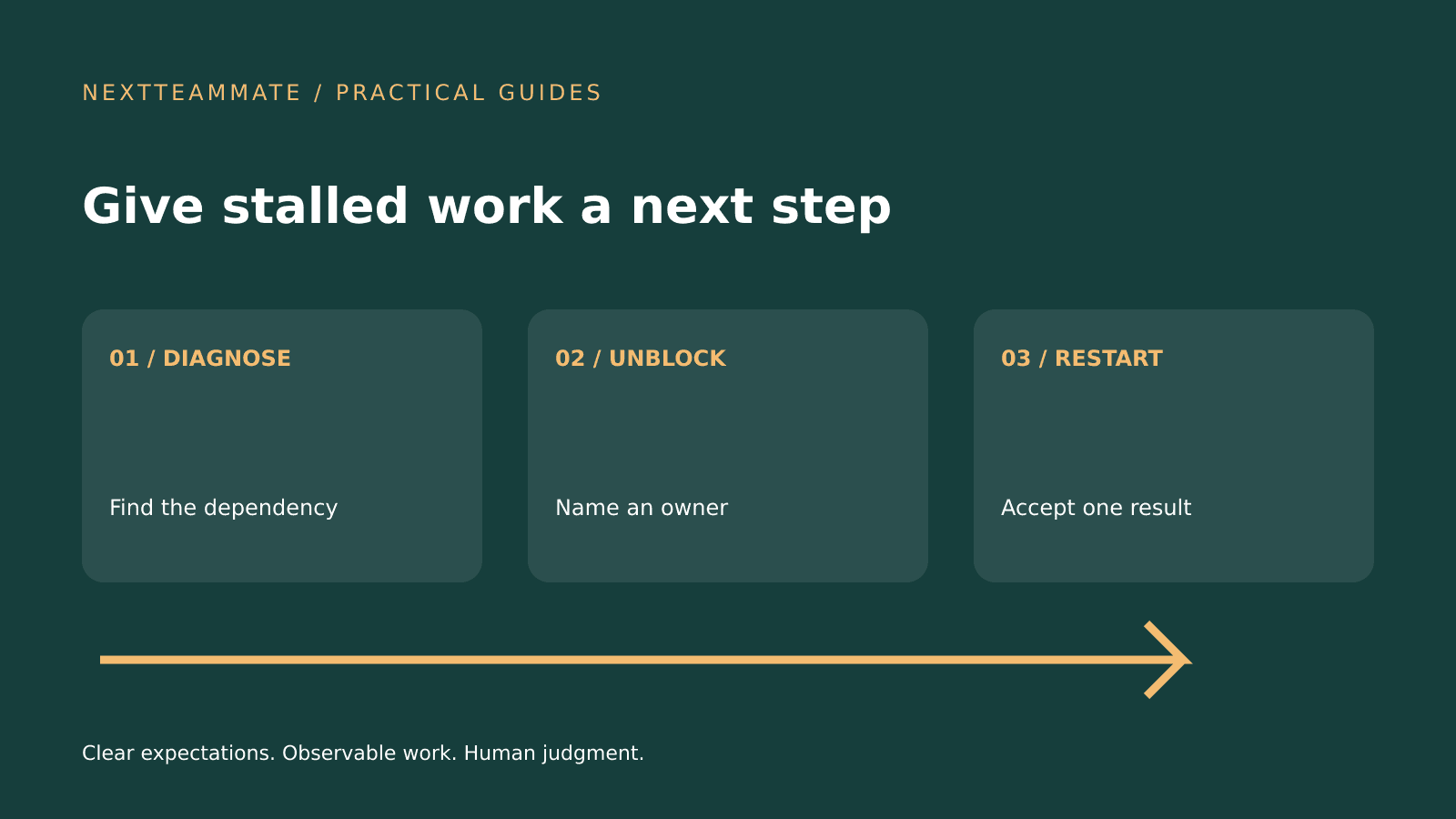
To fix a stalled delegation workflow, identify the last accepted result and the specific dependency preventing the next one. Separate missing access, unclear expectations, client decisions, capacity limits, and capability gaps. Assign each blocker an owner and a response time, then restart with one bounded deliverable. Confirm quality before restoring the full workload or changing the role.
In this guide
Original NextTeammate framework
Key takeaways
- Diagnose the stalled step before sending another reminder.
- Give every dependency an owner and a decision deadline.
- Restart with one accepted result and inspect the cause.
Find the last accepted result
Start with the record rather than the impression that someone has gone quiet. Locate the last deliverable the client accepted, the next requested outcome, and the most recent confirmed instruction. A task marked complete may never have been reviewed, while an unfinished item may be waiting on an approval no one assigned.
Ask both participants for a short account of what happens next. If their answers differ, the workflow lacks a shared state. Write one agreed sentence: “The packet is drafted; the client must confirm pricing before the teammate prepares the final version.” This gives the recovery discussion a concrete starting point.
Sort blockers into actionable categories
Use five categories: access, instructions, decisions, capacity, and capability. Access means a required system or source cannot be reached. Instructions means the result or acceptance criteria are unclear. Decisions means someone must choose or approve. Capacity means the agreed workload exceeds available time. Capability means the person needs a skill they have not yet demonstrated.
A workflow can have several causes. A late report might combine a missing source with an unrealistic due date. Record each cause separately instead of choosing the most convenient explanation. Do not infer low motivation from silence when the record shows an unanswered request for access or a conflicting priority.
Copy this recovery brief
Use the fields: current state; last accepted output; next deliverable; missing input; blocker category; dependency owner; response due time and time zone; permitted interim work; acceptance checks; and next update. Keep the brief in the shared task record so both people can see the current agreement.
Example: “The draft account summary is ready. The client will confirm the approved customer list by Tuesday noon. The teammate will then produce five summaries by Wednesday noon, each with a source link and an uncertainty note. No customer outreach is authorized. If the list is late, post an exception update at noon.”
Ask a question that can be answered
Replace “Any update?” with a request for the missing fact: “Can you open the source folder, and which input prevents the draft?” A useful blocker update names the obstacle, the owner or decision needed, the impact, and the next check-in. It should be brief enough to send before the deadline is missed.
On the client side, answer the actual question or name who can. A vague “please proceed” may not authorize the action the teammate needs to take. If the decision cannot be made yet, reduce scope or agree on an interim output. Keeping uncertainty visible is more useful than asking someone to guess.
Worked example: a customer follow-up queue
A teammate is asked to “follow up with everyone,” but the CRM has duplicate records and no approved message. The client sees no outgoing emails and concludes that nothing has happened. The teammate has been cleaning the list and waiting for wording approval. The stalled workflow is partly a missing authority decision.
Recover by choosing ten fictional or approved test records, agreeing on deduplication rules, and reviewing one draft message. The client confirms the audience and sending authority before live outreach. The teammate then runs a bounded batch and records exceptions. This example illustrates a recovery method; it does not imply that automated outreach is appropriate for every business.
Use AI to organize the diagnosis
An approved AI tool can turn a task history into a list of unresolved questions, conflicting dates, and possible dependencies. Ask it to separate observed facts from suggested explanations and to reference the supplied record. Give it only information permitted under your organization’s data rules.
A generated explanation cannot establish why someone did not act. Check it with the participants. Use AI to draft the recovery brief or compare the output with agreed criteria, then have the accountable person confirm the next action. Do not allow a summary tool to silently change authority, priorities, or deadlines.
Restart small and review the actual output
Choose one recoverable deliverable that can be inspected soon after the dependency clears. Keep its scope smaller than the original backlog. Review the output against written checks, identify remaining uncertainty, and record acceptance or a specific correction. A new promise to finish everything is not evidence that the cause has been resolved.
After one successful cycle, restore work gradually. If the same failure repeats, inspect whether the intervention addressed the cause. Extra reminders will not repair missing access. More training will not resolve a client decision. If capability remains the issue after clear instruction and practice, discuss a different responsibility or support arrangement.
Prevent a quiet relapse
Keep an exception path in the recurring brief: when to flag a blocker, where to record it, who responds, and what work may continue. Review recurring blocked time alongside accepted output. If one person repeatedly delays approvals, change the review window or delegate a bounded decision rather than treating each incident as a surprise.
For a NextTeammate relationship, bring unresolved scope, access, or relationship concerns through the agreed support channel with the relevant task evidence. Avoid including passwords or unnecessary personal information. The goal is a clear owner and next action, followed by a workflow that can run without repeated rescue.
Implementation checklist
Turn the guide into a working plan
- Locate the last accepted deliverable.
- Agree on the current workflow state.
- Classify each blocker using observable evidence.
- Assign an owner and response time.
- Write a bounded recovery deliverable.
- Review the actual output before restoring scope.
- Update the recurring exception rules.
Frequently asked questions
Questions leaders often ask
Why does delegated work stall?
Common causes include missing access, ambiguous acceptance criteria, unanswered decisions, conflicting priorities, and skill gaps. Inspect the task history with both participants before deciding which cause applies.
How do I follow up without micromanaging?
Ask for the specific dependency, its impact, and the next update time. Agree on checkpoints and exceptions in advance so routine work does not require repeated status requests.
Should I replace a virtual assistant when work stops?
First establish whether the person had the necessary information, authority, access, and capacity. If a demonstrated capability gap remains after appropriate clarification and practice, discuss changes to scope or the arrangement.
How can I tell whether recovery worked?
Look for an accepted deliverable after the dependency clears and another successful ordinary cycle. Fewer reminders alone may mean less communication; verified output and visible exceptions provide better evidence.
The AI-Native Work Brief
One practical idea. No AI hype.
Get field-tested delegation systems, useful AI workflows, and new research for building a human-led, AI-enabled company.
Occasional emails. Unsubscribe anytime.
Put the guidance into practice
Find support built around the outcomes you need.
Tell us what you want to get off your plate and review a recommended AI-native teammate.
Get My Free Delegation Blueprint