
AI-native teamwork · 7 min read
AI CRM Manager: Data Quality and Pipeline Follow-Through
Build a human-owned AI CRM manager role for reliable records, lifecycle movement, follow-up queues, reporting, and controlled automation.
For Founders, revenue leaders, agencies, and lean sales and customer teams · By NextTeammate Research · Updated September 22, 2026
Reviewed by NextTeammate Editorial · Published 2026-09-22 · 7 min read
The short answer
Direct answer
An AI CRM manager is a human revenue-operations professional who uses approved AI to maintain record quality, organize lifecycle stages, prepare follow-up queues, reconcile activity, document commitments, and produce decision-ready reporting. They make the CRM more trustworthy without turning probabilistic scores into facts. Sales, pricing, contracts, consent, account strategy, customer treatment, and final commercial decisions remain with authorized people.
Original NextTeammate framework
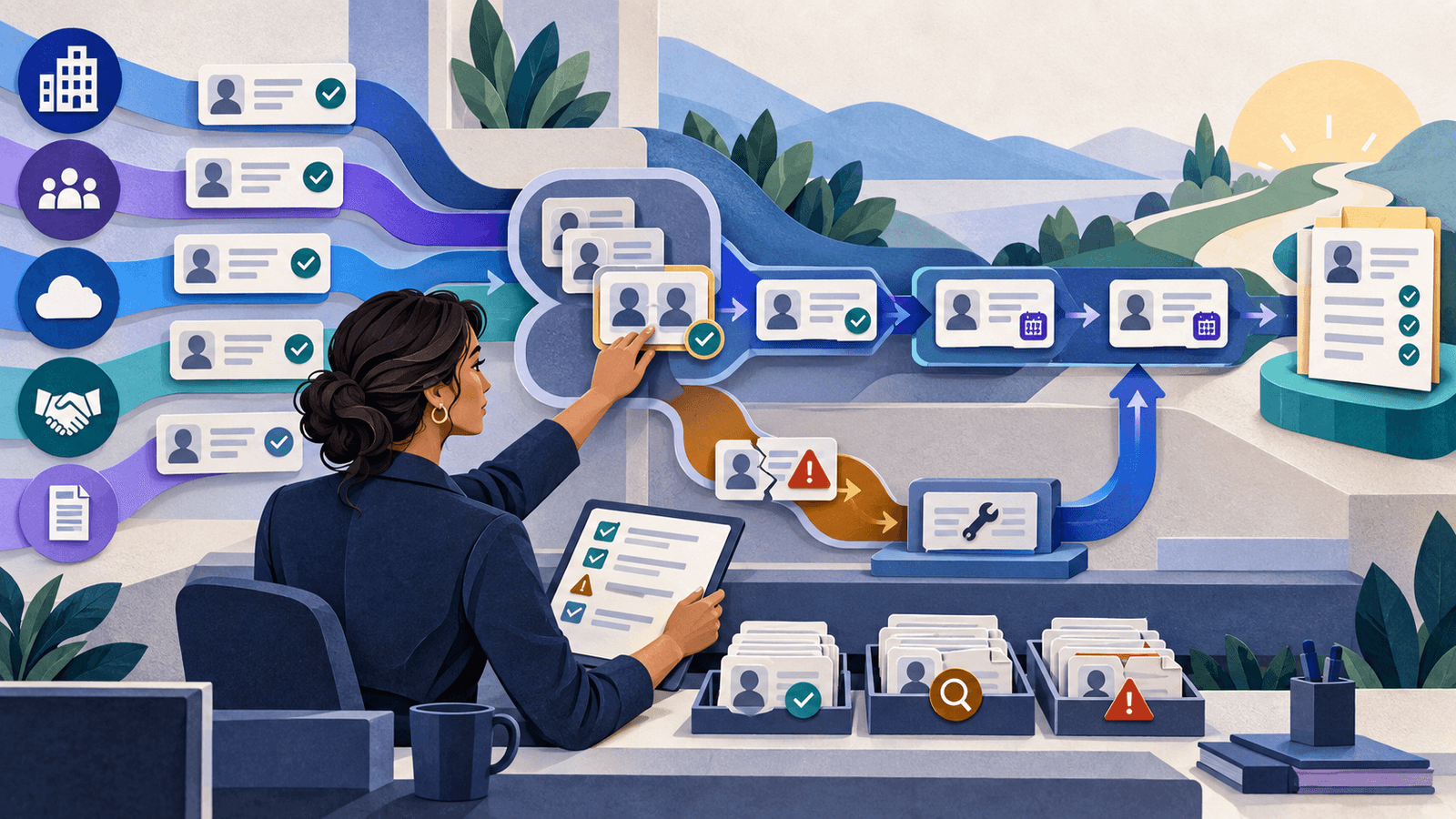
The RECORD Revenue Operations Loop
Key takeaways
- Design the CRM around decisions and commitments, not field completion for its own sake.
- Require source evidence before AI-derived values change authoritative records.
- Measure record trust, follow-through, and pipeline clarity—not database activity.
Define the role through owned outcomes
Start with complete records with defined owners, sources, and next actions, consistent lifecycle stages and timely approved follow-through, visible exceptions, duplicates, stale opportunities, and broken automations, decision-ready pipeline and customer reports with stated limitations. For each outcome, name the trigger, source of truth, recipient, definition of done, cadence, deadline, ordinary authority, required approvals, and meaningful exceptions.
A role charter should explain why the outcome matters and who relies on it. AI fluency may make the lane faster, but the human operator remains responsible for context, verification, communication, and closing the loop.
- complete records with defined owners, sources, and next actions
- consistent lifecycle stages and timely approved follow-through
- visible exceptions, duplicates, stale opportunities, and broken automations
- decision-ready pipeline and customer reports with stated limitations
Use The RECORD Revenue Operations Loop
Run the work as a visible operating loop rather than a collection of prompts. Keep the brief, approved sources, status, decisions, corrections, and next action in systems the organization controls.
Document the ordinary path and at least one difficult exception. A dependable role is defined by what happens when context is incomplete, a source conflicts, a deadline moves, or the tool is unavailable—not by a polished demonstration.
- Define each object, required field, lifecycle stage, owner, source, and permitted transition.
- Capture approved activity and verify identity, consent, source, and relationship context.
- Propose normalization, enrichment, duplicate resolution, and missing-field corrections for review.
- Generate role-specific next-action queues from verified commitments and service standards.
- Monitor automations, sync failures, stale records, unusual bulk changes, and access exceptions.
- Reconcile the report to source records and label assumptions before leaders act on it.
Separate ownership from consequential authority
Create explicit lanes for work the teammate may complete, prepare for review, recommend, escalate, and never perform. Ownership means the operator keeps the process moving and surfaces decisions early; it does not mean every decision is delegated.
Human review must match consequence. Low-risk, reversible work may earn a wider lane after repeated evidence. Decisions affecting rights, money, safety, employment, privacy, binding commitments, or sensitive relationships stay with appropriately authorized people.
- No autonomous pricing, qualification, forecasting verdicts, account exclusion, or customer-impacting treatment.
- Consent, suppression, retention, deletion, and communication-channel rules must be enforced before outreach.
- AI-inferred fields remain proposals until verified against an approved source.
- Exports, integrations, credentials, and bulk changes require least privilege, testing, approval, and recovery plans.
Choose AI for a specific workflow step
Name the step AI supports: discovery, classification, extraction, summarization, drafting, checking, transformation, or reporting. Confirm what data the tool receives, whether it is retained or used for training, which controls are available, and who reviews the output.
Maintain an approved-tool register with owner, purpose, permitted and prohibited information, access method, review requirement, failure plan, and renewal date. More tools do not create more capacity when they fragment sources or increase review burden.
Protect access and confidential information
Use individual accounts and delegated access. Require MFA, grant least privilege, and use a business password manager when a restricted shared credential is unavoidable. Keep authoritative records in controlled systems, review permissions as scope changes, and revoke access promptly.
Minimize information copied into prompts. Customer, employee, applicant, financial, health, identity, privileged, contractual, security, and unreleased information may require stricter controls or exclusion. Honest incident reporting should be immediate and supported, not punished into silence.
Build proactive communication into the role
Proactive communication is useful visibility before a commitment, relationship, or deadline is at risk. Agree on acknowledgement time, update cadence, urgent channel, escalation threshold, and a compact format: what finished, what changed, what is blocked, which decision is needed, and what happens next.
Explain the people and purpose behind the workflow, invite early questions, and give feedback that can improve the next cycle. Relational trust grows through predictable commitments and honest uncertainty—not through constant monitoring or expecting a teammate to guess.
Run a bounded 30-day First Win
Week one documents the role charter and baseline. Week two runs supervised examples. Week three tests an ordinary cycle and a meaningful exception. Week four evaluates accepted quality, review effort, speed, security, communication, and outcome impact before scope expands.
Use real but recoverable work. Test missing context, conflicting instructions, an unusual request, a tool outage, and a decision outside authority. Keep scope stable long enough to distinguish a workflow problem from a one-time learning need.
Measure the outcome, not AI activity
Use a compact scorecard covering records with a verified owner, stage, source, and next action, duplicate, stale, and correction rates, overdue qualified follow-up and commitment closure, automation failures and recovery time, report reconciliation, forecast error, and seller review effort. Compare it with the baseline and include briefing, approval, correction, and recovery time rather than reporting gross hours assigned as savings.
Prompts written, messages sent, tasks touched, content produced, and hours online are not proof of value. The useful question is whether accepted work moves with less leader coordination while quality, trust, and appropriate human control remain intact.
- records with a verified owner, stage, source, and next action
- duplicate, stale, and correction rates
- overdue qualified follow-up and commitment closure
- automation failures and recovery time
- report reconciliation, forecast error, and seller review effort
Avoid the predictable failure modes
Do not hire from a title alone, buy software before defining the workflow, import confidential data without approval, automate ambiguity, measure volume as quality, or expand authority because one demo worked. These shortcuts move hidden risk into the review and recovery stages.
When work misses the mark, diagnose the outcome, context, source, access, skill, rule, review, or escalation gap. Correct the result, improve the system, and decide whether another supported cycle is warranted. Blame without diagnosis teaches people to conceal uncertainty.
Expand responsibility from evidence
Add adjacent work that uses the same context, systems, and relationships. Update the charter, permissions, prohibited actions, approval thresholds, and measures each time scope changes. A coherent role creates more leverage than an unrelated queue of requests.
Hold a monthly workflow and relationship review. Retire unnecessary access, convert recurring exceptions into clearer rules, refresh approved sources, plan skill development, and confirm that AI still improves the work after human review cost is counted.
Implementation checklist
Turn the guide into a working plan
- Name one recurring outcome and its internal or external customer.
- Record the trigger, source of truth, definition of done, and deadline.
- Separate own, prepare, approve, escalate, and prohibited authority.
- Select an approved AI tool only for a named workflow step.
- Use individual accounts, MFA, a password manager, and least privilege.
- Define proactive updates, an urgent channel, and escalation deadlines.
- Test ordinary work, missing context, an exception, and a tool outage.
- Complete human review before consequential action.
- Baseline quality, cycle time, rework, recipient experience, and leader effort.
- Expand scope only after repeated evidence and update access with it.
Frequently asked questions
Questions leaders often ask
What does an AI CRM manager do?
They define record standards, maintain data quality, coordinate lifecycle movement, prepare follow-up queues, monitor automations, reconcile reporting, and surface revenue-operation exceptions.
Can AI update CRM records automatically?
It may update narrow, verified, reversible fields under documented rules. Inferred, ambiguous, sensitive, or commercially consequential changes should remain proposals for human review.
Should AI score or qualify leads?
Scores can help organize review, but they should not be treated as objective truth or silently determine access, outreach, pricing, or service. People must understand the inputs and decide.
How do you prevent CRM automation from sending the wrong message?
Enforce consent and suppression first, test trigger logic, use narrow approved templates, monitor exceptions, preserve an audit trail, and provide a fast pause and recovery path.
What is a good First Win?
Clean one active pipeline segment, verify owners and stages, establish next-action queues, test one controlled automation, and reconcile a decision-ready report to source records.
Which CRM KPIs matter?
Track verified record completeness, duplicates, stale opportunities, overdue follow-up, correction rate, automation failures, report reconciliation, forecast error, and seller time returned.
The AI-Native Work Brief
One practical idea. No AI hype.
Get field-tested delegation systems, useful AI workflows, and new research for building a human-led, AI-enabled company.
Occasional emails. Unsubscribe anytime.
Put the guidance into practice
Find support built around the outcomes you need.
Tell us what you want to get off your plate and review a recommended AI-native teammate.
Get My Free Delegation Blueprint